1
Account details
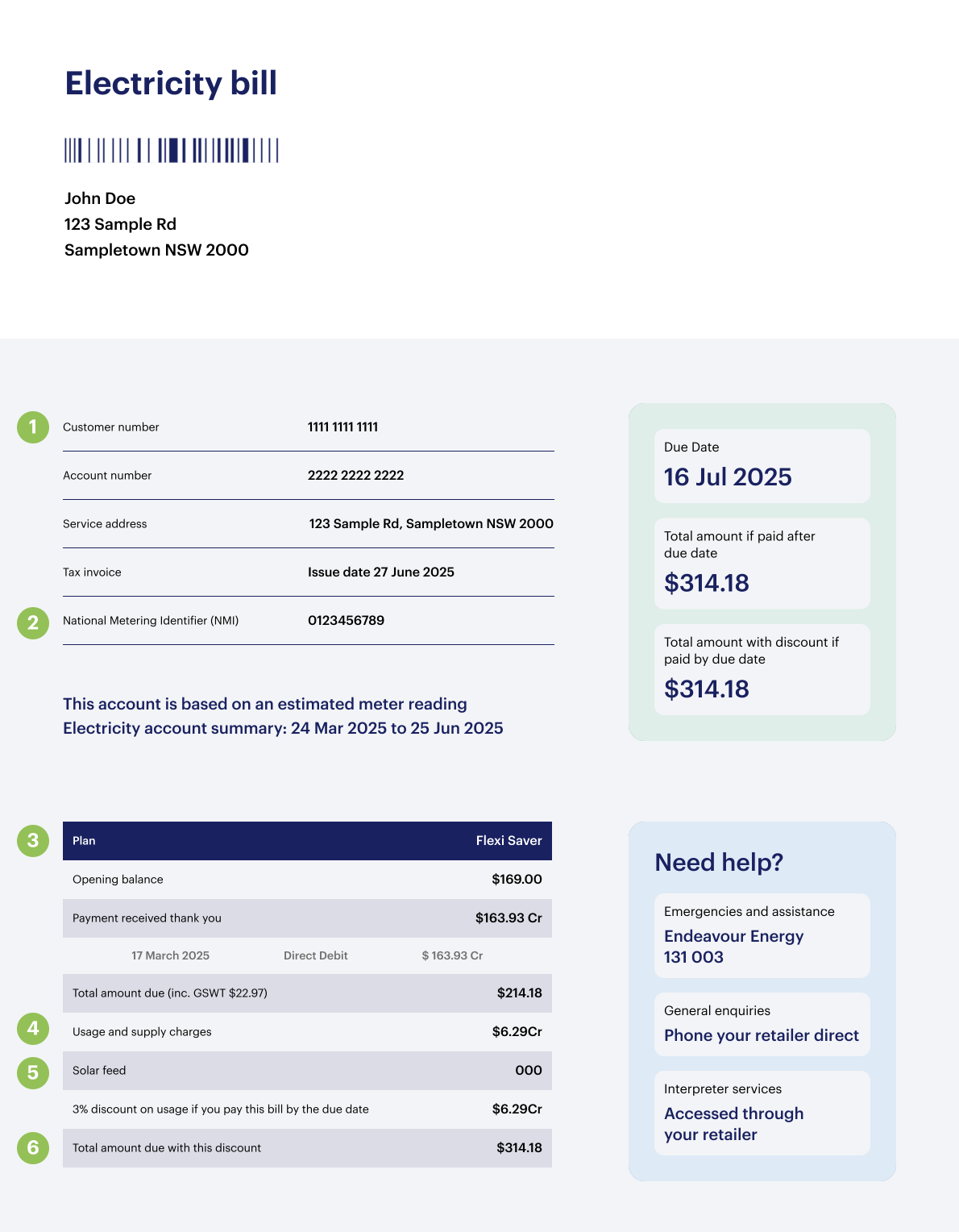
Your name, address, billing period and account number.

Electricity bills can be confusing. Here’s how to make sense of what you're paying for and what you can do to lower your costs.


If you're not sure who your retailer is, check the top of your electricity bill - their name will be listed there.
A standard residential electricity bill includes:
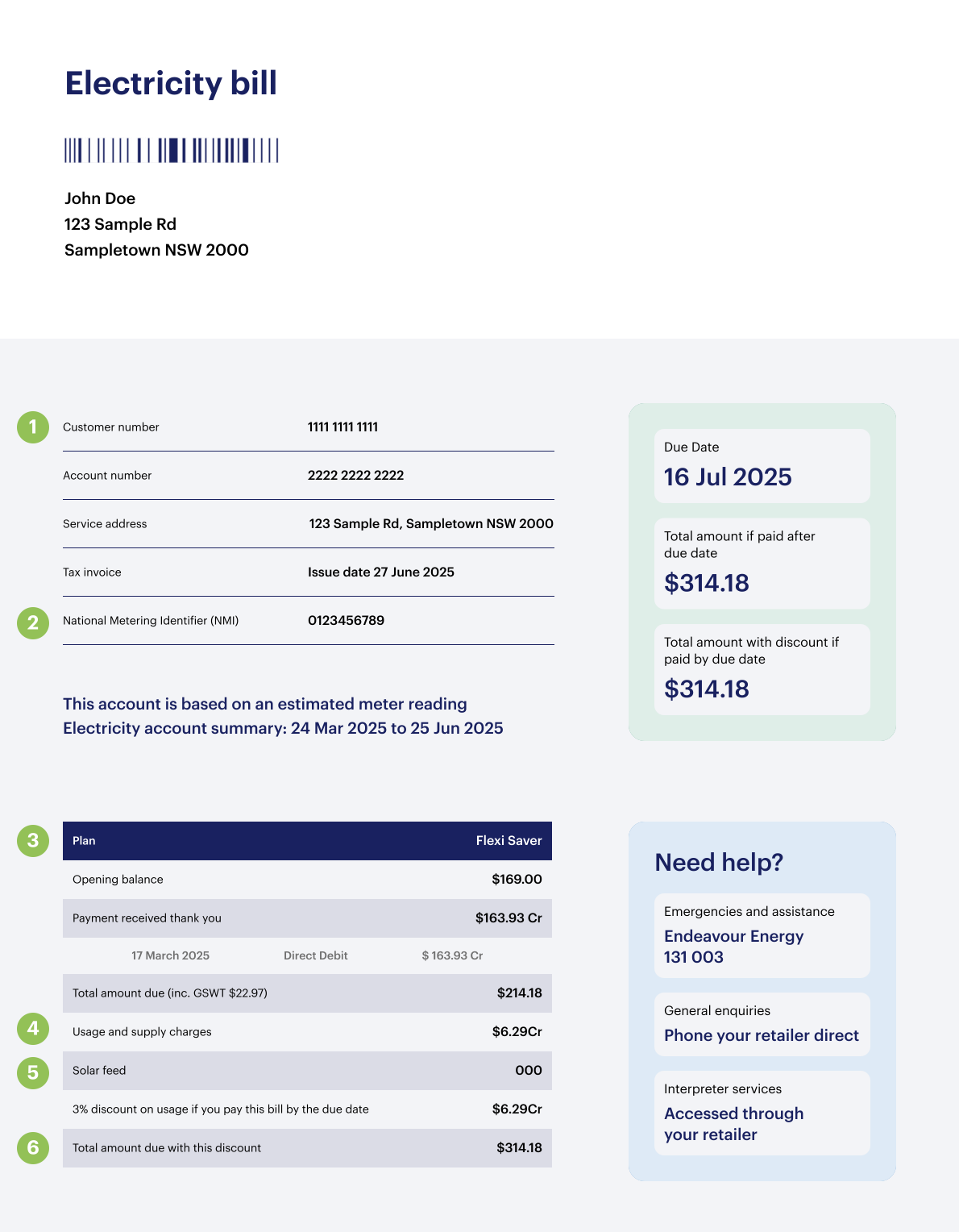
Your name, address, billing period and account number.
A unique number for your electricity supply.
This may show a plan name or more detail to include if you’re on a flat rate, time-of-use or controlled load plan. This affects the amount you’re charged.
A daily fee to keep your property connected to the network.
How much you’re charged for the electricity you’ve used.
Credits for any excess solar energy you’ve exported the grid.
The full amount you need to pay, including GST and any discounts.
Some energy plans charge different rates depending on how and when you use electricity. Understanding your plan can help you save:
Flat rate – Same price no matter when you use power
Time-of-use – Cheaper at certain times of day (eg. during the middle of the day)
Controlled load – Lower rate for specific appliances (eg. hot water)
Your energy use is tracked using meter readings. Your bill will be based on:
Actual read – Taken directly from your meter (manual or smart)
Estimated read – Used if your meter wasn’t accessible
Self-read – Some retailers let you submit your own reading
If you have solar panels and send extra electricity to the grid, your bill might include:
Feed-in credits – What your retailer pays you for energy you export
Net usage – What you used minus what you exported
Daily generation – Some retailers show how much solar you generated
Community battery – Access to a lower rate if you’re connected to a community battery
If you have received a defect notice from us, you may be eligible for financial assistance.
We undertake regular inspections on our poles and wires to ensure service and safety. These inspections also include private assets such as poles and service mains.
Private assets found to be unsafe will be issued a 'Report of Inspection - Customer Defect' that explains the defect and what is required to rectify it. A defect could include a rusting or rotting private pole or damage, vegetation that encroaches on service mains or damage to overhead consumers mains, etc.
We recognise some customers are unprepared for the unexpected cost of urgent repair works required to maintain the safety of your property and our network. While customers are obligated to comply with defect notices, we may be able to assist in getting these defects rectified with an affordable interest-free repayment plan.
If you are finding it difficult to pay upfront for rectification work, we encourage you to reach out to us and seek assistance.
You may be eligible for a variety of reasons, including:
Eligible customers can benefit from:
Phone 131 003 for more information or to apply